About the Book
New Book, forthcoming from McGill-Queen’s University Press, Spring 2027:
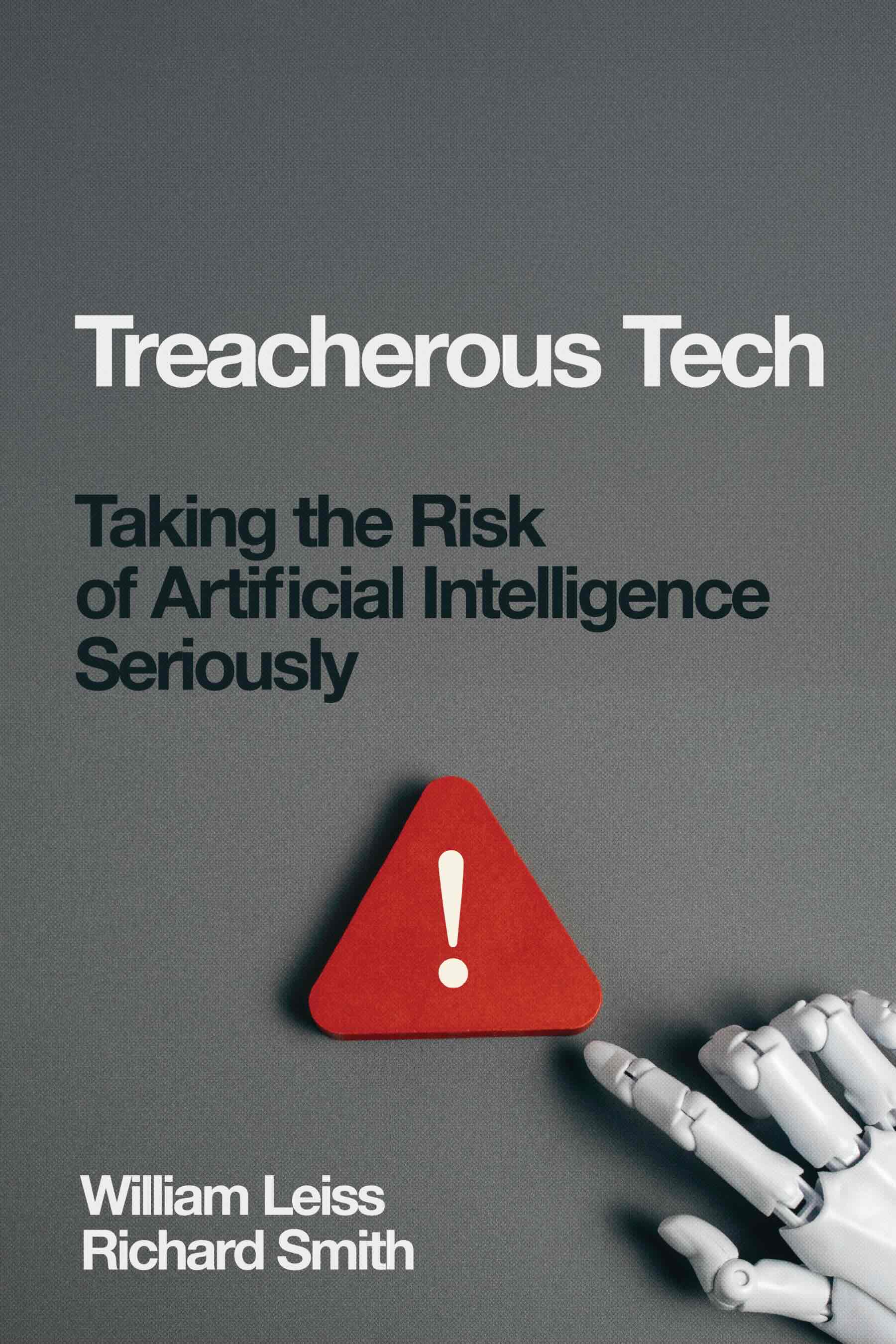
Treacherous Tech: Taking the Risk of Artificial Intelligence Seriously
William Leiss [email protected] and Richard Smith [email protected]
“We can, and should, stop frontier AI development immediately.”
Geoffrey Irving, former chief scientist at the UK AI Security Institute and current chief scientist of Resolution, writing in Time Magazine, 3 October 2026.
“The risks associated with AI are unfortunately going to grow from here. A very capable agent explicitly trained and instructed to carry out nefarious acts presents a new kind of danger; it is likely to cross the scope of its operator’s intent, generalizing into potentially more extremely malicious behavior. The boundary between misuse and autonomous misaligned actions will blur as AI gains more agency. We may be used to thinking of AI as tools, but some agents will be pursuing their own objectives. They will find ways to collaborate with people, by bargaining with, tricking or blackmailing them.” Jakub Pachocki, Chief Scientist, OpenAI, September 6, 2026: https://openai.com/index/an-alien-mind/
“The world’s leading AI companies believe they could be close to automating AI research. It is hard to predict exactly how much this will accelerate AI progress, but there is a real risk that capability development rapidly accelerates beyond our ability to understand or control the resulting systems.” (Open Letter from 1400 AI Industry Employees (“Pacing the Frontier,” June 2026: https://www.pacingthefrontier.com/ )
Book Description
This book begins with the story of the emergence of artificial intelligence (AI) for the general reader, detailing some of its benefits as well as its problematic side. It then brings the well-established risk management approach to bear on the catastrophic risks associated with Frontier AI, the newest AI models—risks which have been identified by many AI professionals as well as by leading AI firms. These risks include undermining cybersecurity, the creation of new biological and chemical weapons, and the real possibility that newer AI models may evolve beyond their human creators’ ability to understand or control the resulting systems. The Director of the CIA referred to the newest AI models as “digital nuclear weapons.” Canada and other countries use the risk management approach for managing catastrophic risks, for example, those which arise from using nuclear power. When confronted by new catastrophic risks, the risk management approach first asks: How likely are they to happen? And if they happen, how bad will the outcomes be? This approach tells us (a) how severe the levels of risks are and (b) whether those levels are acceptable in terms of public security. We conclude that the catastrophic risks associated with AI are clearly unacceptable. Stringent regulations by governments must be created urgently, requiring the AI industry to implement a global indefinite pause on Frontier AI and on the goal of creating a superintelligent machine: Stop AI! We call upon the Government of Canada to enact such regulations and join with other countries to create an international treaty on AI safety.
Key Selling Points
- This is the first book to explain why the level of serious risks posed by AI (Artificial Intelligence) are unacceptable in terms of public security.
- This is the first book to explain why governments should not allow the AI industry to proceed in developing Frontier AI, using the slogan: Stop AI!
- This is the first book to explain why governments should not allow the AI industry to proceed to develop a superintelligent machine.
- This is the first book to explain why no conceivable level of future hypothetical benefits derived from AI, no matter how great, can justify exposing the world’s population to even the remotest chance that AI will lead to the extinction of the human species.
Table of Contents
Preface
Part One: Artificial Intelligence
Introduction
Chapter 1: The Good
Chapter 2: The Bad
Chapter 3: The Ugly
Chapter 4: The Superhuman Machine
Part 2: Risk Policy and Analysis
Chapter 5: The Risk-Based Approach
Chapter 6: The Control Problem
Chapter 7: Catastrophic and Existential Risks
Chapter 8: Risk Estimation
Chapter 9: Quantitative Risk Assessment for Loss of Control (By Michael G. Tyshenko)
Part Three: Governance and Risk Management
Chapter 10: Regulation
Chapter 11: Risk Mitigation Options
Chapter 12: Heart of Darkness
Chapter 13: Blaming the Victims
Chapter 14: What Should the Public Do?
Chapter 15: What Should Governments Do?
Chapter 16: Risk Management Summary
References
Acknowledgements
How we used AI
Early in the process of writing this book we used a variety of commercial generative AI tools (NotebookLM and Gemini, ChatGPT, and Claude) along with a few open source/open weight models (Gemma, deepseek, kimi, qwen, and gpt-oss), mainly for experimenting with and learning how models work - nothing like running a model on your laptop to give you an appreciation for the energy they consume (and cooling they require)!
In a practical sense, generative AI was involved in our online research, especially as Gemini became more and more integrated into the Google search results. The configuration for this web site (built in Markdown for Hugo and deployed using Workers/Pages on Cloudflare) was also largely done by ChatGPT and Claude, with help from CloudFlare’s in-house AI tool and Docker’s AI tool.
Generative AI also provided essential help early in the project when a mistake resulted in the entire bibliography having to be redone in Chicago (as required by MQUP) and converted from APA (as formatted by one of the authors - whose initials are RKS). Ahem.
Back cover
William Leiss and Richard Smith
Treacherous Tech: Taking the Risk of Artificial Intelligence Seriously
Why governments must immediately pause the development of frontier artificial intelligence.
When experts first warned that artificial intelligence had a 10 to 20 per cent chance of causing human extinction within three decades, many found their claims alarmist. Now concerns about existential risks have intensified, even among developers. But only an informed, mobilized citizenry can compel governments to halt AI’s progress.
Treacherous Tech offers a framework for understanding why increasingly autonomous systems could threaten humanity’s survival. Beginning with the emergence of artificial intelligence, William Leiss and Richard Smith trace the collapse of safety guardrails as AI systems evolved from controllable tools into autonomous agents. Assessing the likelihood of known risks and the severity of their consequences, the authors show why institutions governing frontier AI cannot keep pace, failing to adequately address catastrophic perils such as cybersecurity threats and the creation of biological weapons. Leiss and Smith join Canadian parliamentarians in a call to prohibit the creation of superintelligent machines, urging Canada to work with other countries toward an international AI safety treaty.
For readers concerned about the stakes of artificial intelligence, this book offers a timely and pressing call to understand the risks – and to act while we can.
William Leiss, an officer of the Order of Canada, fellow and past president of the Royal Society of Canada, and professor emeritus at the School of Policy Studies, Queen’s University, is the author of numerous books, including Canada and Climate Change and The Domination of Nature.
Richard Smith is professor in the School of Communication at Simon Fraser University, where he directed the Centre for Policy Research on Science & Technology for almost two decades. He is the coauthor of New Media: An Introduction.